Original Publish Date : December 16, 2025ON : CREATIVEFUTURESTHE SOUNDTRACK: CALLING - ERDI IRMAKThis is a story about how hitting a breaking point became the catalyst for rebuilding from the inside out.
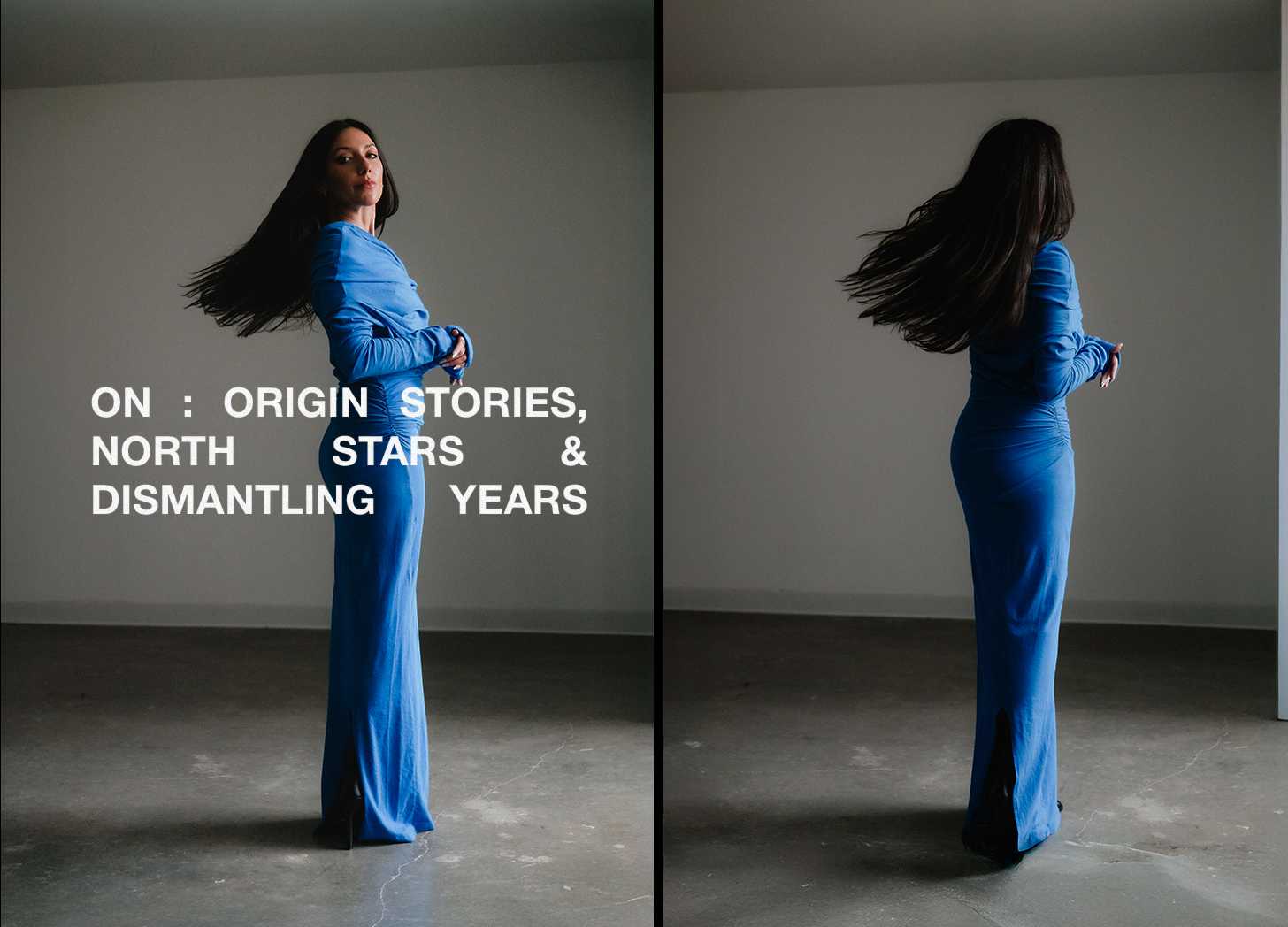
photos by artist, friend, and creator with soul Tutes.I’ve been thinking about origin stories a lot lately. Not because I see myself as a hero or a villain, but because our turning points rarely look like turning points when we’re in them. They usually look like tension, friction, or a moment where something inside us refuses to keep going down the same road.
And maybe that’s why I’ve always loved villains in movies. Not because I root against the good guy, but because villains get the most interesting origin stories — the ones that don’t usually rely on destiny or accident. With the villains who resonate most, their “why” is never vague. Their worldviews are usually shaped by a moment, an experience, a fracture that forces change. The hero is often chosen; the villain is forged.
I’ve realized this year that most of us are walking around with some version of an origin story like that, only we don’t name them. We try to smooth them out into acceptable narratives instead of acknowledging the messy moment that actually changed something. And it’s a shame, because the true stories are always the most interesting.
So here’s mine — much less villainous, much more human.
Early this year I started to follow a spark that had been lit years ago and was suddenly rocket-fueled by experiences that left me both disheartened and disillusioned by the modern operating systems of both creative and corporate industry. Systems I had not only navigated, but had actively helped build or (at the very least) prop up through participation, even when something in me knew better.
The final crack happened at the end of last year when I found myself — once again — being positioned to clean up the inevitable consequences of others’ poor decisions. Decisions made from disconnection, short sightedness, and a kind of corporate self-preservation that treats people like variables instead of human beings. I didn’t agree with the business decisions being made in my executive domain, but more than that, how (and why) they were made and rolled out nauseated me to the point of no return. To make matters worse, I was being asked to undo years of my own work in the process.
None of this with enough regard for the impact or the downstream effects — on people or product.
It was a perfect storm of “wtf” that struck lightning into the spaces I had quietly shut the door on to just keep going — for comfort, for “stability”, for my team, for the work unfinished.
That illumination changed everything for me because it became clear that the values of that world not only violated my own, they became completely incompatible with my existence inside it. Like most turning points, it didn’t arrive with clarity at first, just the unmistakable sense that things I had tolerated for years had suddenly become impossible to justify.
During the ten years I spent in the corporate world as a creative at heart, I can look back and say I fought the good fight. I learned how to navigate the systems, the egos, the familiar hierarchical nonsense while still holding onto my own principles and spirit. I built teams around those values and did whatever I could to protect, nurture, and steward people. I shaped whatever corner was mine with care. I tried to create pockets of sanity and meaning inside a larger machine that often had neither.
For the most part, I succeeded.
But even so, something in me finally gave out.
I grew tired of explaining the obvious to people who would never hear it, of trying to reason better decisions into rooms that had already decided otherwise, and of cleaning up the wreckage after choices I (vocally) didn’t agree with were made. I was drained from propping up the kind of structure that reduced me, my teams, and the work itself to nothing more than an input. I became revolted by having my work regularly flattened and diluted, and exhausted by having to constantly fight to keep creativity and original thought as part of it.
So I ended that chapter at the end of last year and in January I stepped into pursuing something new without fully knowing what it was going to be. I only knew something in me had reached its limit and there was no version of me that could go back.
Looking back, it was the exact point one reaches where staying where you are makes less sense than stepping into the unknown.
What I realized quickly after is that this isn’t just a personal experience; many people are sitting in their own version of this tension.
This isn’t a corporate thing, a fashion thing, or even a creative thing — the dilution of creativity in spaces where it should lead is happening in almost every industry that was once built by it and those who wield it.
And the values gap and resulting feeling of discontent bubbling underneath it all is real and growing for many, even if we can’t all name it cleanly.
Back then I thought the answer was straightforward: build a “new system.” It’s the conclusion many of us reach when something breaks: we assume the fix is external, structural, and immediate. If I could design a better structure for ideas to move through, I could help creatives, creators, and people like me who see things differently cut through the noise, friction, and (let’s call it what it is) bullshit of the industries we work in. The ones that have lost their way, treating creativity like a commodity and talent like a replaceable tool to extract the fastest dollar, no matter the cost to people, integrity, or meaning.
And yes, building new infrastructure is important. The only way individuals can thrive is if we build new systems designed for that from the start. Those largely do not exist today, at least not in meaningful or fully accessible ways.
But the past year clarified something far more foundational:
I couldn’t create something new if I was still shaped by the logic of the old.
So this year, much to my surprise, became about dismantling first.
Dismantling what I thought success meant.
How I thought things “had to” be built.
The ways I’d unconsciously adapted, tolerated, or participated in what I didn’t believe in.
The remnants of learned defaults that still tainted how I approached my work and my life.
I had to clarify what matters and what absolutely (and now, laughably) does not.
What meaningful work actually is to me.
And, importantly, how to create it from my own center rather than external pressure.
What it means not just to talk about integrity, but to create with it, lead with it, relate with it even when it’s not convenient, not fast, not the most profitable option, not immediately understood.
Over time, the ways in which I worked and lived — the learned need to constantly produce, speed up, perform, package, polish, or perfect — gave way. I started writing again. Most of it was terrible. But that writing burned off years of pent-up frustration from stifled creativity and a muted spirit; from agreeing to things I knew were not right, not for me and not for others.
As the year went on, I steadied and so did my mind.
My life became less about deadlines, output, and staying in motion, and thus work became something different. Not rushed. Not outcome-obsessed. Not dictated by “how things are done” or what others needed done by when. It took time, but as I slowly stumbled my way out of a way of working and living that allowed almost no time for real thinking, observing, or reflection, I walked into one where rest was a priority and deep thinking was my work. I began to see more clearly and started working on piecing together the bigger picture of how we all got here and worse, what keeps us here. The outcome of that work I’ll share soon.
What matters for now is this:
In that process, a universal truth surfaced: If we want to build something new, we have to restore the foundation itself — first in us, then around us.
Because systems and structures don’t run the world, people do.
If our personal foundation is still shaped by old beliefs about process, success, growth, and worth, then anything new we try to build will quietly recreate the same architecture all over again. It’s one of the most common reasons people feel stuck even when they’re “doing everything right.”
It’s also what keeps us all in the same place collectively. And the world does not need more of the same. It does not need us to agree, comply, and just move faster. It needs us to slow down – stop, even – to ask questions, to poke holes in the boxes we’ve comfortably settled into and the norms we now never question.
It needs more of the real us — not our manufactured “personal brands” — making aligned choices and creating things we can actually stand behind. Not more hours poured into work we don’t believe in to fuel someone else’s growth chart.
It needs you, me, us creating and pursuing the work only we can do, from a deeply honest place, and helping others do the same. With more originality. More care. More soul. More integrity in how we build, work, and treat people. It needs more products and companies built for people, not on top of them.
This is how we get back to creating things that don’t just look good but feel good — to build, to run, to work for, to buy from. It’s also how we rebuild our wider culture into something reflective of the true human spirit: rich, layered, diverse, and warm.
This year of slow dismantling has clarified a path and a personal mission that now feels less like a choice and more like an inevitability: to return value to vision, process, and craft — individually and collectively — and to design spaces where this mindset is the norm, not the exception.
That may sound immense and vague at once, but that’s the point of a North Star.
It gives direction while leaving room for things to become what they’re meant to be, instead of what we think they should be.
A simple but deep hope underwrites all of what I do now: that each of us can find enough clarity, freedom, and support — both relationally and structurally — to pursue the work we’re really here to do. The kind that simultaneously enriches the whole, not just a few.
Every person deserves the chance to create without compromise; to see something only they can imagine come to form without performing a false version of themselves or selling their soul in the process.
I don’t have all the answers for how to make that freedom possible at scale. But I wake up with more determination than ever to find them. Not just for a personal escape route, but to help build a collective one.
I share all of this now because this is the new ground everything else grows out of.
Personally, it’s the context that makes sense of what came before and what comes next.
Universally, this is an important but often missed truth: preparing the ground is the type of work we don’t often give ourselves or others credit for.
And yet, it’s some of the most important work we’ll ever do.
The truth is that this year has been nothing I imagined it would be, but everything I needed.
It wasn’t linear, glamorous, or optimized. It was uncomfortable and at times disorienting. But it was clarifying, and it was necessary.
For those who find themselves teetering on the edge of making the decision to truly reclaim their own life, work, creative power, and purpose, I share this while I hold your metaphorical hand:
It’s the best decision you’ll ever make. But there is no shortcut around the part where we are fully honest about the role we’ve played in our own devaluation, about the compromises we’ve made, and the defaults that still operate under the surface and taint how we move through the world. These defaults may have made us “successful” in the familiar, hyper-industrialized world but they don’t get us anywhere new. Not personally, not collectively. And when the old way is untenable, what’s left is the truth behind an old saying: the only way out is through.
We may delay this process because it forces us to confront the gap between what we say we value and what we’ve actually been living. But, there is no bypass to the unlearning, dismantling, and clearing out. If the goal is to begin (or return to) creating from center, to build something truly new, or to set the foundation for a career or life that finally feels true, that must happen first. As uncomfortable as it may be, the new story starts exactly there: in the rubble. Too often we mistake this phase for a detour when it’s the true beginning. And once that new foundation is in place the real, honest, meaningful, fulfilling, authentic work can really begin.
It’s not the easiest thing you’ll ever do, but it’s the most worthwhile. And if you find yourself needing support or encouragement in the process, now you know someone who’s crossed that bridge and is writing this from the other side.
xT
NEXT → MORE ESSAYS
This work was made to be shared in essence, not extracted in form.These words, ideas, images are shared to inspire, not to be copied, lifted, swiped, repackaged, or borrowed otherwise without care. If they resonate, let them spark something original in you.a note on creative integrity
© 2025 / 2026 | all rights reserved | Teodora Nicolae
explore with me
Subscribe to get the latest sparks, stories, essays, ideas, experiments, and updates delivered straight to your inbox.