Original Publish Date : September 3, 2025THE SOUNDTRACK: Soul of Stars (Anton Ishutin Remix) - Arsen Ibregimov, Surmillo, Niana, Anton IshutinON : CREATIVEFUTURESOn : How Creative Culture
Lost Its Center
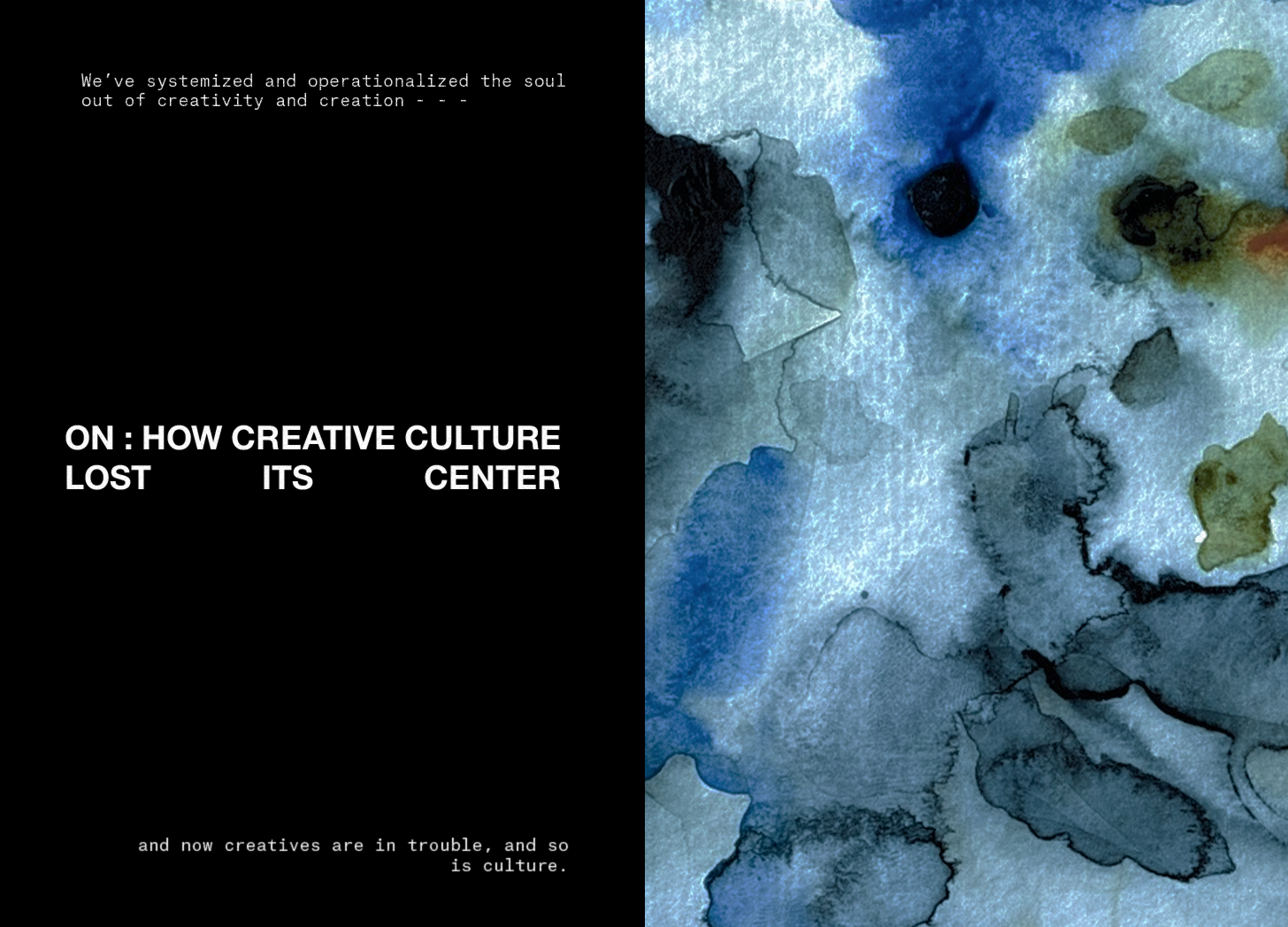
But now, we find ourselves in much less inspiring spaces, places, and with a deep sense of thirst for something to make us feel, well, anything. Perhaps you happen to be sitting in a 17th century palazzo right now or on a pristinely restored 1950s sailboat. In which case, revel in the creativity and skill that poured out of humans to bring that idea into form. But if you’re in any modern building or walking the streets in any modern city, chances are, it all feels more hollow. Less beautiful. Less soulful. More optimized. Less intentional.
And if we’re honest, the same can be said about how most of us approach our own work or how we take in others’.
Even when we come across something with the potential to move us, we’re often skimming past it too quickly to notice or to even care. When’s the last time something truly took your breath away? When’s the last time you let it?
This isn’t just about the plight of creativity in its modern definition or of creative industries, although architecture, art, film, fashion, music, entertainment, travel, design, are all suffering from the same affliction most visibly. It’s also about our food systems, beauty and health industries, and even how we build cities and communities.
When I first felt the spark that eventually became The Dreamers, I thought it was about creating better structures to hold creatives, creativity, and ventures differently. That was my first answer to the breakdowns we’re witnessing across industries—the creative economy collapse, the hollow sea of sameness and homogeneity.
But I’ve come to see that is only the surface. The rupture runs deeper and these visible cracks are just symptoms. What’s really at stake is our relationship to creation itself, individually and collectively.
Because before it’s professional, it’s personal. It is, after all, us who got us here.
It’s not that systems devalued originality, vision, and creative work. People did. We did. Not just executives or gatekeepers, but many of us. Even those who think of ourselves as the creative class.
Most of the time, it’s not even conscious. It’s adaptation.
We adapted and started trading expression for efficiency, originality for acceptance. We had to, to survive and find success in a world that rewards speed and scale above all else.
We began producing instead of expressing. Copying instead of originating. Finding the fastest and most efficient way, instead of the most beneficial way.
Delivering deliverables instead of stewarding ideas.
The unraveling didn’t happen overnight, it happened every time we chose safe over true.
Over time, original thought, the creative process, and creative work has become suppressed, stifled, systemized, devalued, and chronically watered down. Not because it was inevitable, but because we started to believe the lie that originality was a luxury, not a necessity. That big vision was less valuable than guaranteed short-term return. That creativity was merely a means to an end. That creating was something we only do if we can make a living from it, or that unless it could be scaled, monetized, or algorithm-approved, it wasn’t worth pursuing.
And so, bit by bit, the most human of instincts—to imagine something only we can and bring it into form—was numbed.
And then we forgot.
What it feels like to think beyond what already exists.
We forgot happens when originality—not optimization—leads and that creativity isn’t content, it’s a life force.
To imagine new ways of doing things, to care about the process at all, to create from truth and what it means to follow a vision without apology or algorithm.
And if you’ve ever felt the dull ache of going through the motions, you already know this.
We’ve forgotten that brands aren’t moodboards, they start with a point of view, and that products that change the world don’t come from trends. They come from imagination and original thinking.
We’ve been taught to monetize faster instead of imagining deeper, to compete instead of collaborate, to transact instead of connect.
We’ve forgotten that strategy isn’t sterile, that systems can have heart, and that creativity isn’t a luxury—it’s the origin of everything.
Worst of all, we’ve forgotten that creative work is the most valuable work of all—and yet it’s been devalued more than anything else in our economy.
We forgot, not all at once, but slowly until busyness became our belief system. We got too busy to remember as we swiped, scrolled, saved, and screenshot our way to “vibes” masquerading as vision. We got too busy to stop and feel into whether what we were pursuing, delivering, and agreeing to fed us, and if how we did things impacted others.
Maybe some of us noticed along the way, but the fear became louder than our discomfort—what would happen if we skewed from the way things are? Would we be accepted if we disagreed? Could we still make a living not doing it the same way as everyone else? Will the algorithm like my art? If I push for change and innovation, will I be able to keep my hamster wheel, soul destroying job?
Then our individual disconnection rooted, spread, and grew into a collective one. We didn’t see it coming but we should have. Because when we produce, templatize, optimize for scale, ROI, output, and being accepted instead of authentic we dilute, hollow out, and create a sea of sameness.
We no longer create culture, we homogenize it. We don’t nurture it, we sterilize it.
And here we are.
So, what may have seemed like a grandiose opening statement is not a bold attempt at grabbing your attention, dear reader. I said it because, while it may be uncomfortable, it is deeply true: what we’re facing isn’t just a creative crisis—it’s a cultural one. And at heart, a spiritual one too.
But here’s the good news: the most human of all longings—to create something true, only what we can—has not disappeared. In a world overwhelmed by mediocrity and sameness, it’s louder than ever, whether we know how to listen to it or not.
There’s nothing more human than the creative spirit that runs through all of us. It’s time to remember what it feels like to shape or steward a story, a product, a system, a movement—because it matters. Because it’s honest. Because it doesn’t yet exist. Because it came, and could only come, through you. And more so, to remember what it means to imagine new things and new ways of doing them, instead of rehashing the same forms out of habit, fear, or convenience.
It’s the human creative spirit, in its true form, that is the driver and reason for every major moment, invention, uprising, groundbreaking art movement, and evolutionary shift in human history. From the wheel to the printing press, the light bulb to the iPhone. From the Renaissance to jazz, from A Trip to the Moon to Picasso’s cubism. From democracy in Athens to the civil rights movement to building rockets that carried us beyond Earth. This human creativity at its best, most potent, and most powerful.
This isn’t about taking power back, we never lost it. It’s about reconnecting with ourselves and choosing how to use it now: to imagine without apology, to bring forward what only we can, and to refuse to mistake efficiency for value or extraction for originality ever again.
Because the future of creative culture will either be written by algorithms and markets—or by us. It’s our choice.
xT
Look around you right now. What do you see?
The chair you’re sitting in.
The notebook you write in.
The art on the wall in front of you.
The last book you read.
Each thing you engage with every moment, tangible, experiential, or otherwise started with an idea. These ideas used to be overwhelmingly original and would be stewarded into form with integrity, no matter how long or short the process. This made for a rich cultural landscape—interesting art, brands with a point of view, groundbreaking products, and experiences that left an imprint.
NEXT → MORE ESSAYS
a note on creative integrity
This work was made to be shared in essence, not extracted in form.These words, ideas, images are shared to inspire, not to be copied, lifted, swiped, repackaged, or borrowed otherwise without care. If they resonate, let them spark something original in you.