Original Publish Date : January 31, 2025ON : JOURNEYINGTHE SOUNDTRACK: ENTA OMRI - EVREN FORTUNAThis is a story about arriving somewhere expecting to be received and realizing what’s already been taken.
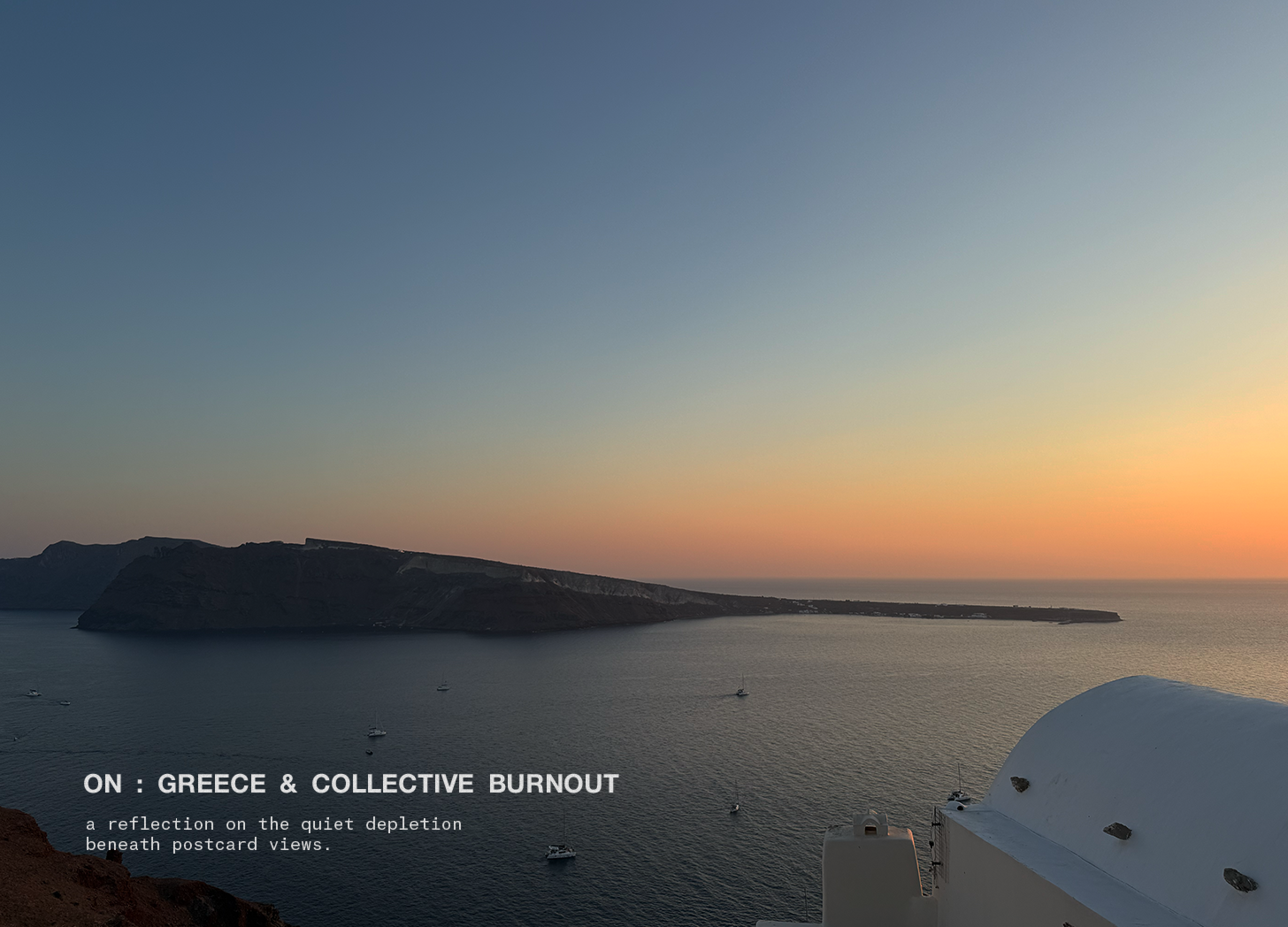
My first few days in Greece, I felt an underlying confusion. It was, of course, beautiful. And as with all brand new places and spaces I visit I was grateful for the feeling that walking streets I’ve never traversed stirs up. But, relationally, I was a bit puzzled.
I couldn’t understand why, when trying to make conversation, I was very often met with disinterest.
Blank stares.
Dismissal in more extreme cases, and a general lack of energy in milder ones.
Was it me? A cultural misunderstanding?
Was I an anomaly no one knew how to engage with, a friendly tourist among a sea of rude ones?
(There were many.)
Was my brand of open friendliness too much for the Greek, whose stoicism is well documented going back thousands of years — etched into philosophy and culture?
I pondered this for days as it shifted from experience to experiment: could I get a local to crack a smile?
Of all the countries I’ve visited, I’ve very rarely been told I couldn’t be sat, couldn’t make a reservation for one, or couldn’t take an empty table for a quick lunch. I know how this sounds, but hang with me while I risk the optics and say this plainly for the sake of clarity. As a solo female traveler who’s worked in service in younger years and goes out of her way to engage consciously and respectfully, I wasn’t expecting to be turned away and feel that much disengagement that often.
But in Greece, tourism is more than an industry, it’s survival.
So the open two-top must be reserved for two.
The pool lounge is priced for two, not one.
And there is — so sorry — but no flexibility.
The people I encountered were kind. Helpful. Hardworking. That must be said. But beneath the surface (and often visible on it) there was something else: a slowness, a heaviness, a deep fatigue.
Not disinterest. Depletion. Perhaps even grief.
It was then that experiment turned into investigation
So I ate my gyros quickly to make room for the next guest and thought about the economy — the ever-looming threat of collapse, and what that does to a person, a government, a culture.
I guzzled from my water bottle under the blazing sun, trying to make it a bit farther down the path to Fira and thought about what it takes to work in this heat day after day.
I sat on my freshly whitewashed terrace and took in the view — one of the most spectacular I’ve ever seen — and realized the people to whom this view really belongs may never get to enjoy it the way I just did.
How the best property, not just in Imerovigli but across the entire island of Santorini, isn’t theirs anymore.
How every perfect sunset, from every prime vantage point, is consumed by people who don’t live there.
How TripAdvisor or Google reviews have more power to destroy a livelihood than any earthquake.
I watched a pack of drunk Americans loudly stomped toward the next taverna, after clearly having too much at the last one, and thought about what kind of stomach it must take to endure this — day after day, season after season, year after year.
How detachment might be the only way through it.
Eventually, I recognized the undercurrent because I’ve felt it.
It wasn’t disinterest.
It was burnout on a on a collective scale that stretched far beyond any one place.
And it made perfect sense.
I didn’t understand this on arrival, but as the first few days passed, the context of this experience became incredibly clear. This was August — deep into high season, and close to its breaking point. Both Athens and Santorini in August are not just busy, they are saturated. The city and the island are operating at full capacity after months of continuous arrival: cruise ships unloading thousands at a time, narrow streets never empty, service workers working without pause under relentless heat, knowing that this window — these few months — has to carry the year.
By the time I arrived, the exhaustion wasn’t subtle. It was cumulative. End-of-season tired. The kind that doesn’t reset overnight.
And so, the disinterest I thought I was clocking was actually something else entirely: what was left and what could still be offered.
Deeply mustered interest, actually, at the tail end of a season that asks for endless warmth, patience, and availability often without the ability to rest, retreat, or opt out.
This is what happens when a place, a people, and a system have been commodified to the point of depletion.
When beauty is extracted and repackaged as experience.
When tourism becomes both lifeline and leash.
When a civilization that gave the world philosophy, medicine, democracy, and architecture is now forced to serve cocktails and smile politely to survive.
Beauty, power, legacy — drained to survive.
I don’t have a neat ending for this to package up what I learned in those first few days. Just a growing awareness that sometimes what looks like disinterest is grief, what feels like rejection is exhaustion. That sometimes a blank stare is just unintentional detachment.
And that maybe it’s not about expecting perfect hospitality, but carrying more reverence than demand in places that have already given us so much.
xT
© 2025 / 2026 | all rights reserved | Teodora NicolaeNEXT → MORE ESSAYS
a note on creative integrity
This work was made to be shared in essence, not extracted in form.These words, ideas, images are shared to inspire, not to be copied, lifted, swiped, repackaged, or borrowed otherwise without care. If they resonate, let them spark something original in you.